 DIY Proof
Coffee table in the kitchen: the nook that earns its floor space
A coffee table in the kitchen earns its place when it sits in a dead nook, not the cooking zone. What to measure, which materials survive grease, and why a bench beats chairs.
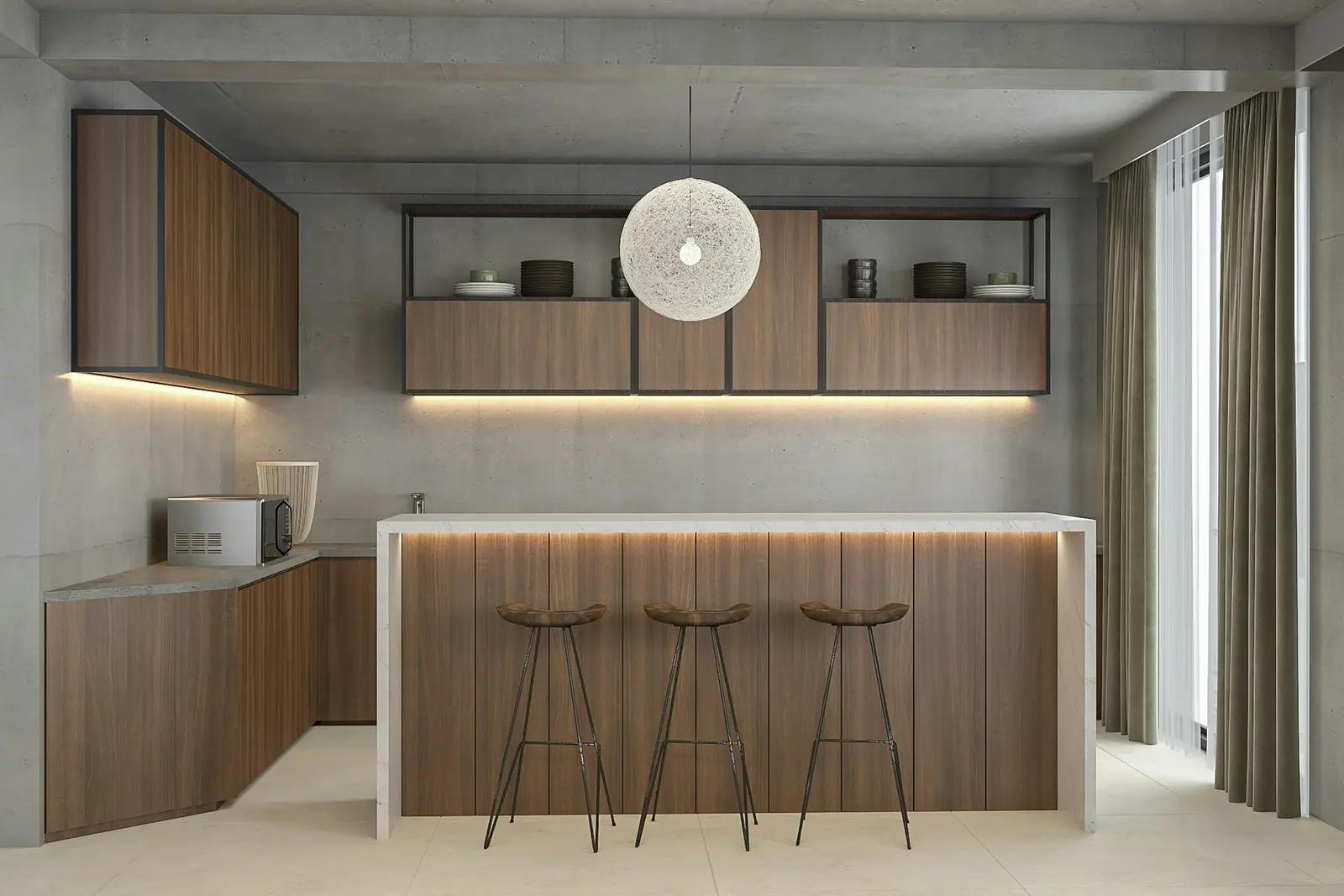
Coffee table in kitchen ideas only pay off when the table lands on floor you already don't use. That is the whole trick. Park a table between the hob and the fridge and you'll lift it out of the way twice a day. Put the same table in a nook by a window and a room people only cook in becomes a room people sit in.
The nook that actually got used
D'Ara Nazaryan, who founded the florist Aris Florals in Los Angeles, ended up with two coffee tables. She bought the first, a vintage marble table in mixed colours, eight years earlier as her first proper furniture purchase. Lulu & Georgia then sent her one from a new line, and she assumed the old table would go back to the living room. She kept both.
The newer table went into a small nook in her kitchen, a corner that also leads to her bedroom door and that she says she wasn't using much. A bench went in front of two large French windows beside the nook. That is the pattern worth copying: bench against the glass, table in the alcove, walking route to the next room left clear.
Find the dead floor before you buy anything
Spend a day noticing how you move. Four routes matter: door to sink, sink to hob, hob to fridge, and the path anyone takes to reach another room. A table can sit on any floor that isn't on one of those lines. It sounds obvious until you watch yourself and realise you always cut the same corner.
Then check everything that swings. The fridge door, the oven door, the dishwasher door, cupboard doors under the worktop, and the kitchen door itself. An alcove that looks generous with everything shut can be unusable with the dishwasher open. If a chair has to sit behind the table, allow room for it to push back; a bench slides underneath and needs nothing.
- Measure the gap at floor level and again at table-top height. Alcoves are rarely square, and skirting boards take width where the table legs sit.
- Check the overhang. A 100 cm top on a narrow base needs more floor than a 90 cm top with the same footprint, and the corners are what catch a hip.
- Mark the footprint on the floor with masking tape and leave it there for a week before you commit.
Height tells you what the table is for
Kitchen worktops sit around 90 cm high, dining tables around 75 cm, coffee tables 40 to 45 cm. Put the lowest of those three next to the highest and the gap explains the job. The coffee table holds a drink, a bowl of flowers, a plate of things to pick at. It doesn't hold a chopping board, and it's a poor place for a hot tray.
This is the part people get wrong. They picture themselves prepping at the new table, then spend the first week standing at the worktop exactly as before. Treat the table as the kitchen equivalent of a side table: somewhere to put things down while you talk to whoever is sitting on the bench.
Materials that survive steam and cooking fat
Everything in a kitchen collects a thin film of fat, and porous surfaces collect more of it. Sealed stone and oiled wood wipe clean. Bare wood doesn't, and it swells at the first spill. Glass looks sharp for about a week before every fingerprint shows. Rattan and cane suit a corner, though the weave traps crumbs and needs tipping out.
Marble, which is what the table in the Los Angeles kitchen is, needs care. Wine, lemon juice and tomato are acidic and will etch a polished top if you leave them sitting. A hot pan taken straight from the hob can crack it through thermal shock. A shallow tray for drinks and a trivet for anything hot solve both problems for a few euros.
Keep the top low
A tray corrals glasses and a candle, and lifts off in one piece when you need to wipe underneath. A low bowl of flowers works because it doesn't break the sightline from the doorway, which is exactly why the florist's own table reads as calm rather than crowded. Tall vases in a small kitchen make the room feel tighter and are the first thing to get knocked over.
What usually goes wrong
- The table fits the nook but blocks the route to the bin, so it gets dragged out every evening.
- The top is much wider than the base, which looks fine on paper and catches hips in practice.
- A hot pan goes from hob to marble and leaves a crack that no polish will hide.
- Children treat a low table in a kitchen as a step. If yours would, wait a couple of years.
- The table turns into a dumping ground for post and shopping bags within a fortnight, and nobody sits near it.
Pros
- Uses floor space you weren't using anyway
- No fixing, no wiring, so it suits renters
- Free if you move a table you already own
- Gives guests somewhere to perch while you cook
Cons
- A low surface beside standing-height work is only good for drinks and flowers
- Picks up a film of cooking fat that needs a weekly wipe
- Bad placement blocks the walkway
- Marble and bare wood need care with heat and acid
What it costs
The source article doesn't publish a price for the table, so there's no euro figure to quote and I won't invent one. The realistic spend is a bench, a tray and a trivet, plus whatever a secondhand table costs if you don't already have one. Buy the bench new, because it has to take weight, and anchor it to the wall if children will sit on it.
For scale, the same publication's San Francisco bedroom project, a 150-square-foot room, came to around $12,000 in materials and furnishings. Moving a table into a nook is the cheapest change you can make to a kitchen, and the one with the least to go wrong afterwards.
When to skip it
Galley kitchens with a single walking route have no dead floor, and no arrangement of furniture creates any. Households with toddlers who climb get a hard corner at head height. If the floor is needed for a highchair, a buggy or a laundry airer, those win without argument. A table is a nice extra; a clear floor is not negotiable.
- Time:
- One afternoon to set up, then a week of walking past it before you decide to keep it there.
- Difficulty:
- Beginner. No fixing to the fabric of the room, no plumbing, no electrics.
- Cost:
- No fixed figure. The source article doesn't publish what the table cost. Budget for a bench, a tray and a trivet; the table itself can be one you already own or a secondhand find.
Tools: Tape measure, Masking tape, Spirit level, if you're adding a bench, Screwdriver or hex key for bench assembly, Drill and wall fixings for the bench anti-tip strap
Materials: The coffee table, ideally one you already own, A bench sized to the window or alcove, Felt pads for the table legs, A shallow tray, A trivet
- 01
Watch your routes
Walk from the door to the sink, the sink to the hob, the hob to the fridge, and out to the next room. Note the floor you never cross. That's the only place a table can go.
- 02
Measure the nook and the table
Take the width and depth of the alcove at floor level, then the width and depth of the table top. Remember that the top overhangs the base, and that skirting boards narrow the floor.
- 03
Mark it out in tape
Lay masking tape on the floor in the shape of the table top. Leave it down for a week. If you find yourself stepping over the tape, the spot is wrong.
- 04
Check the swings
Open the fridge, oven, dishwasher and every cupboard door near the tape. Open the kitchen door too. Nothing should touch the marked area.
- 05
Set the table and pad the legs
Move the table in and fit felt pads so it slides without scratching tile or timber. Set it slightly off the wall so air can move behind it and the top doesn't mark the paint.
- 06
Place the bench
Put the bench under the window or against the wall opposite the table. Check the seat height clears the table top by roughly 25 to 30 cm so knees fit underneath.
- 07
Anchor anything children will climb
Fit the bench anti-tip strap to the wall. This is the one piece of fixing worth doing, and it takes ten minutes with a drill and the right plug for your wall.
- 08
Dress the top and live with it
Add the tray, the trivet and a low bowl. Clear the top completely once a week to wipe off cooking fat, and move the table out for a proper floor clean every month or so.
Frequently asked questions
- Can you put a coffee table in a kitchen?
- Yes, if it sits in a nook or corner outside the walkway between the hob, sink and fridge. A table in the middle of the cooking zone gets shifted every time you cook. Put it where the floor is already dead and it stops being in the way.
- How much clear space do you need around a kitchen coffee table?
- Leave at least a metre of floor on the side you walk past, and check that the fridge, oven and cupboard doors open fully with the table in place. In a narrow galley kitchen that usually rules a table out, and a slim console against the wall is the better answer.
- What height should a kitchen coffee table be?
- Standard coffee table height, roughly 40 to 45 cm, if people will sit on a bench or a sofa beside it. That is well below a 90 cm worktop, so treat it as a surface for drinks and flowers rather than prep.
- Which table material holds up best in a kitchen?
- Sealed stone and oiled wood cope with daily wiping. Glass shows every smear and fingerprint, and rattan collects crumbs in the weave. Whatever you choose, use a trivet under hot pans, because marble and some stones can crack from thermal shock.
- Will a coffee table make a small kitchen feel cramped?
- Often, yes. The setup that worked in the source home used a nook beside a window, so it reads as extra seating rather than an obstacle. If your kitchen has no dead floor, skip the table and leave the space clear.
Sources
Next projects
Burgundy kitchen makeover under $500: where the money goes
A wine-bottle colour cue, a weekend of wall painting and a hard look at prep. How to plan a burgundy kitchen makeover that stays under $500, and where the money actually goes.
How to build a folding step stool from scraps for $20-$80
To build a folding step stool you need five parts, four bolts and a strap hinge. Here's the cut list in inches and millimetres, the order to work in, and where the wobble comes from.
Basic tool kit for beginners: 8 categories, not 80 items
A basic tool kit for beginners is eight categories and a drill, not 200 pieces. Where to spend, what to save on, and the Pozidriv trap waiting in European flat-pack.